

As a supplier of large UV printers, I'm excited to share with you how these remarkable machines work. Large UV printers have revolutionized the printing industry with their ability to print high - quality, durable images on a wide range of materials. In this blog, we'll take a deep dive into the inner workings of large UV printers.
The Basics of UV Printing
UV printing is a digital printing process that uses ultraviolet (UV) light to cure or dry the ink almost instantly. Unlike traditional printing methods that rely on evaporation or absorption of the ink into the substrate, UV printing uses a chemical reaction triggered by UV light to solidify the ink. This process offers several advantages, including faster production times, better adhesion to various materials, and the ability to print on non - porous surfaces.
Key Components of a Large UV Printer
1. Print Heads
The print heads are the heart of a large UV printer. They are responsible for depositing the ink onto the substrate. Modern large UV printers often use piezoelectric print heads. These print heads contain tiny nozzles that can be controlled electrically. When an electrical charge is applied, the piezoelectric material inside the print head deforms, forcing a small droplet of ink out of the nozzle and onto the substrate. The size and placement of these droplets are precisely controlled to create detailed and accurate images.
2. Ink System
A large UV printer requires a sophisticated ink system. The ink used in UV printing is specially formulated to be cured by UV light. It typically consists of monomers, oligomers, photoinitiators, and pigments. The monomers and oligomers are the building blocks of the ink that form the solid structure when cured. Photoinitiators are chemicals that absorb UV light and initiate the curing reaction. Pigments are what give the ink its color. The ink system also includes ink cartridges or tanks, pumps, and valves to ensure a consistent supply of ink to the print heads.
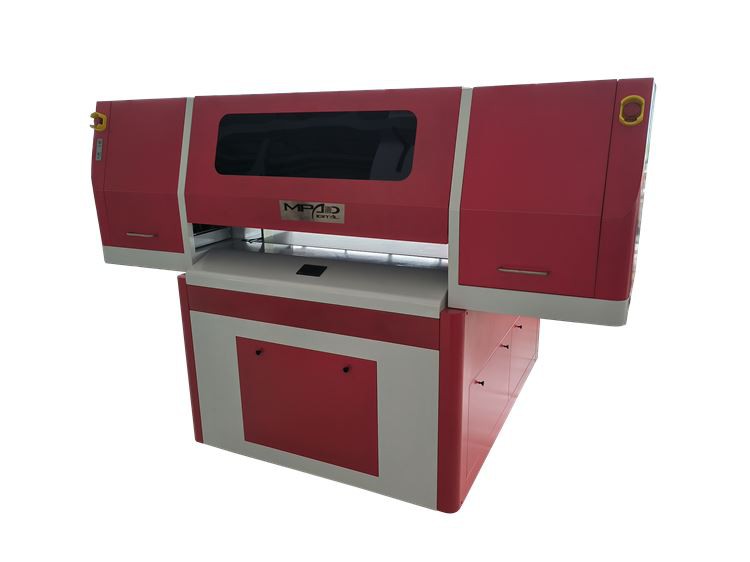
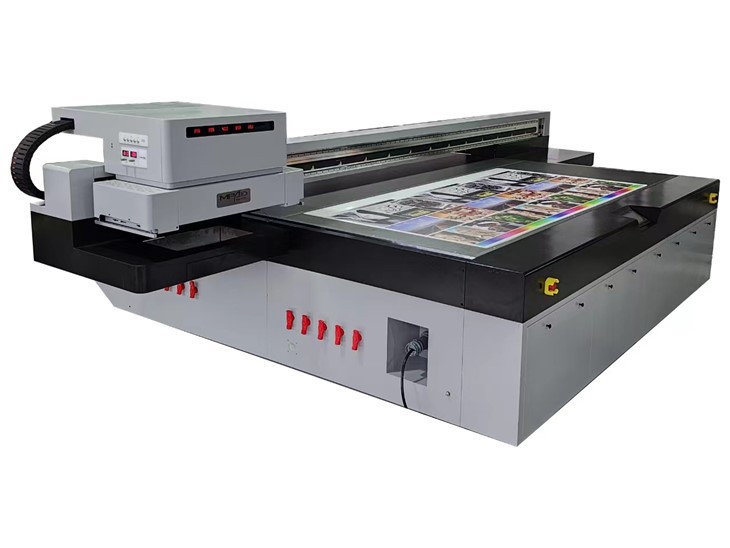
3. UV Lamps
UV lamps are essential for the curing process. They emit ultraviolet light at specific wavelengths that are designed to activate the photoinitiators in the ink. There are different types of UV lamps used in large UV printers, such as mercury lamps and LED UV lamps. LED UV lamps are becoming increasingly popular because they are more energy - efficient, have a longer lifespan, and generate less heat compared to mercury lamps. The UV lamps are usually positioned close to the print heads so that the ink is cured immediately after it is deposited on the substrate.
4. Substrate Handling System
The substrate handling system is responsible for moving the substrate through the printer. In a large UV printer, this can be a conveyor belt system for flat substrates or a rotating drum system for cylindrical or irregularly shaped objects. The system must ensure that the substrate moves smoothly and accurately at a consistent speed. This is crucial for achieving uniform printing quality across the entire surface of the substrate.
5. Control System
The control system of a large UV printer is the brain of the operation. It manages all the functions of the printer, including the movement of the print heads, the supply of ink, the operation of the UV lamps, and the speed of the substrate handling system. The control system is usually connected to a computer, where operators can input printing parameters such as image resolution, color settings, and print speed. It also monitors the printer's performance and can detect and alert operators to any issues or malfunctions.
The Printing Process
1. Pre - Printing Setup
Before starting the printing process, the operator needs to prepare the printer and the substrate. This involves loading the appropriate ink into the ink system, ensuring that the print heads are clean and properly calibrated, and positioning the substrate on the substrate handling system. The operator also needs to select the appropriate printing settings on the control system based on the type of substrate and the desired print quality.
2. Image Transfer
Once the setup is complete, the printer begins the image transfer process. The control system sends signals to the print heads, instructing them to deposit ink droplets onto the substrate according to the digital image. The print heads move back and forth across the substrate, creating a series of rows of ink droplets. The size and density of these droplets are adjusted to create different colors and shades, allowing for the reproduction of complex and detailed images.
3. Curing
As soon as the ink is deposited on the substrate, it passes under the UV lamps. The UV light emitted by the lamps activates the photoinitiators in the ink, causing a chemical reaction that quickly turns the liquid ink into a solid. This curing process happens almost instantly, which means that the printed image is dry and ready to be handled immediately after printing.
4. Post - Printing
After the printing and curing process is complete, the substrate can be removed from the printer. Depending on the application, the printed product may require additional finishing steps, such as coating, cutting, or laminating.
Applications of Large UV Printers
Large UV printers have a wide range of applications. They can be used for printing on flat materials such as wood, glass, metal, and plastic sheets. For example, they can be used to create signage, displays, and decorative panels. They are also capable of printing on three - dimensional objects. You can explore more about printing on unique items like golf balls through our UV Printer Golf Balls page.
In the commercial sector, large UV printers are highly valued. They are used in industries such as advertising, packaging, and interior design. Our Commercial UV Printer is specifically designed to meet the high - volume and high - quality printing needs of commercial businesses.
If you are looking for a machine that can handle flatbed printing with precision, our UV Flatbed Printer Machine is an excellent choice. It can print on a variety of flat substrates with great accuracy and speed.
Conclusion
Large UV printers are complex and sophisticated machines that combine advanced technology and precise engineering to produce high - quality prints. Understanding how they work can help you make informed decisions when it comes to choosing the right printer for your needs. Whether you are a small business looking to add custom printing capabilities or a large corporation in need of high - volume production, a large UV printer can offer many benefits.
If you are interested in learning more about our large UV printers or have any questions about the printing process, we encourage you to contact us for a detailed discussion. Our team of experts is ready to assist you in finding the perfect solution for your printing requirements.
References
- “UV Printing Technology: A Comprehensive Guide.” Industry Print Magazine, 2022.
- Smith, John. “Advances in UV Ink Formulation.” Journal of Printing Science, 2023.
- Brown, Sarah. “The Future of Large - Scale UV Printing.” Manufacturing Today, 2024.